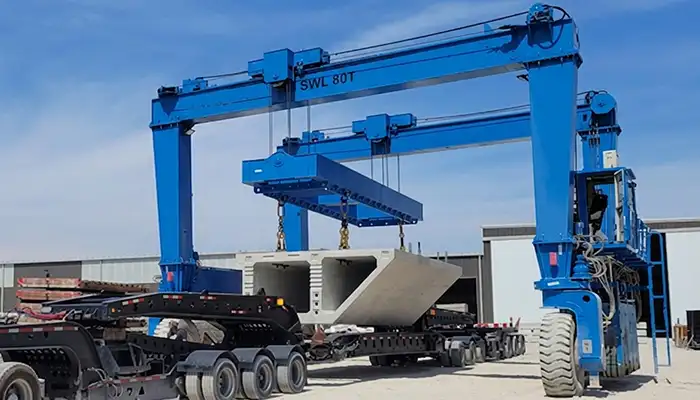
RTG Gantry Crane 80 Ton for Bridge Projects in Philippines
menu_open
Content Quick Link
RTG Gantry Crane for Highway Girder Projects in the Philippines
Built for Philippine Infrastructure
In the Philippines, most infrastructure projects are long-term works such as highways, bridges, and expressways that are built step by step across wide and changing job sites. For contractors and site engineers, the requirement is usually very simple and direct: "Sa site, kailangan mabilis, safe, at walang komplikasyon." (On site, it must be fast, safe, and simple.) This is why many bridge and highway projects choose an RTG gantry crane for girder handling.
Why this matters on real construction sites
Bridge construction is not done in one fixed location. The work moves forward as each section is completed, so equipment must also move with the project.
- Lifting points change as the bridge extends
- Precast girders need to be moved between zones
- Site space is often open but uneven
- Different teams work in the same area
In this situation, a fixed crane system is not always practical.
How RTG gantry crane helps on site
A rubber tyred gantry crane is useful because it can move directly on the construction ground without rails or fixed paths.
- It can travel along the bridge alignment
- It supports lifting and moving heavy girders
- It can follow different work zones on site
- It reduces waiting time between lifting tasks
For site teams, this means the workflow becomes smoother even when the layout keeps changing.
Practical benefit for project efficiency
On many infrastructure projects, delays are not caused by lifting capacity but by equipment mobility and setup time.
When a crane can move freely while handling heavy loads such as 80-ton precast girders, planning becomes easier for engineers and contractors, and site coordination improves significantly.
Why RTG is widely used in Philippine bridge projects
That is why RTG gantry cranes are widely used in bridge and highway construction projects in the Philippines, especially for precast girder installation work where flexibility, mobility, and fast repositioning are critical.
The combination of safe lifting, easy movement, and reduced setup time makes it suitable for long-term infrastructure development sites.
What Contractors and Project Managers Actually Need on Site
In highway and bridge projects in the Philippines, contractors are not simply choosing a crane. They are trying to keep the whole site moving without interruption. A crane is not just equipment here. It is part of the daily workflow.
Typical On-Site Requirements
On most bridge construction sites, the lifting needs are quite consistent and directly linked to daily progress.
- Lift precast bridge girders up to 80 tons safely and repeatedly
- Move girders across long and open construction areas
- Work in different lifting points as the bridge progresses
- Operate outdoors under changing weather conditions
- Keep lifting operations stable without frequent stops
In simple terms, the crane must keep up with the construction pace, not slow it down.
Common Reality in Philippine Projects
In actual field work, contractors often face similar situations across different infrastructure projects.
One common expression heard on site is:
"Hindi pwedeng naka-station lang ang crane." (The crane cannot stay in one fixed place.)
This reflects how dynamic the construction environment is, where work zones and lifting points keep changing.
Operational Challenges on Site
Besides lifting capacity, project teams usually deal with practical on-site constraints that affect progress.
- Tight schedules where every delay affects the next stage
- Multiple subcontractors working in shared areas
- Limited space for large fixed crane installations
- Frequent changes in lifting positions as construction progresses
These conditions make coordination and equipment mobility just as important as lifting strength.
Why Flexibility Becomes Essential
On paper, many lifting solutions look similar, but real site conditions change quickly. Space shifts, work zones move, and schedules become tighter.
That is why flexibility is not treated as an extra feature, but as a basic requirement for project success.
- Equipment must move with the job
- Setup time must be minimal
- Operation must stay consistent even in changing layouts
For many project managers, this is where an RTG gantry crane becomes a practical solution for bridge and highway girder handling work.
Why RTG Gantry Crane Fits Philippine Construction Style
In many infrastructure projects across the Philippines, work on site is not fixed or repetitive. It moves step by step, and conditions can change quickly. Because of this, equipment choice is usually very practical. A rubber tyred gantry crane (RTG crane) is often selected because it fits how contractors actually build roads and bridges in daily work.
Mobility Across the Entire Jobsite
On highway and bridge projects, work areas are long and spread out. A crane that cannot move easily will slow down the entire construction sequence.
An RTG gantry crane provides practical mobility advantages on site:
- No rails required for movement
- Can travel directly along the construction alignment
- Can shift between different lifting points on the same project
- Works well in staged construction areas where work keeps advancing
This allows site teams to follow the construction flow without interrupting lifting operations.
Practical for Fast-Moving Projects
In Philippine construction work, timing is always critical. A delay in one section can directly affect the next stage of the project.
A common contractor mindset is:
"Bilis ng trabaho, bawas gastos sa idle time." (Faster work means less cost from idle time.)
RTG cranes help reduce waiting time between lifting and installation tasks, allowing girders to be handled immediately without long setup adjustments.
Designed for Real Outdoor Conditions
Most bridge and highway projects in the Philippines are exposed to changing weather and open-site environments. Equipment must remain stable and reliable under these conditions.
RTG gantry cranes are widely used because they are suitable for continuous outdoor operation:
- Operate in tropical heat and humidity
- Can handle rain during construction periods
- Suitable for both coastal and inland job sites
- Built for long-term outdoor working conditions
This makes them well matched to the real environment of infrastructure construction sites.
Less Dependence on Multiple Equipment
In many projects, using multiple lifting machines can create coordination challenges and slow down daily operations.
With an RTG gantry crane, site management becomes more simplified:
- One unit can lift, move, and position precast girders
- Fewer machines are needed on site
- Coordination becomes easier for project managers
- Workflow becomes more stable and predictable
This helps reduce operational pressure and keeps construction progress steady.
Project Material – What Is Being Lifted
In highway and bridge projects in the Philippines, most lifting work is focused on precast concrete components. These are long, heavy structural elements that require careful handling during installation. That is why an RTG gantry crane is commonly used, as it can handle both the weight and length while moving safely across the site.
What Materials Are Commonly Lifted
In daily bridge construction work, contractors mainly handle precast structural components that require stable and controlled lifting.
- Precast concrete girders for highway bridges
- Bridge beam segments used in section assembly
- Long structural components requiring balanced lifting
These materials are not only heavy but also sensitive to imbalance during lifting and positioning.
How Materials Are Handled on Site
On actual construction sites, material handling is a full process rather than a single lifting action.
- First, girders are lifted from storage or casting yard
- Then they are transported across the site to installation points
- Finally, they are carefully positioned onto bridge supports
Each step requires controlled movement where stability is more important than speed.
Typical Specification (Project Reference)
| Item | Details |
|---|---|
| Maximum Weight | 80 Tons |
| Application | Bridge / Highway Construction |
| Handling Type | Lift + Move + Positioning Support |
| Material Type | Precast Concrete Girder / Beam Segments |
| Working Condition | Outdoor construction site with variable ground conditions |
What Buyers and Engineers Should Focus On
For procurement teams and project managers, the key concern is not only lifting capacity but also how the material behaves during handling.
Precast girders typically require:
- Stable lifting without sudden movement
- Controlled travel across uneven ground
- Accurate positioning during installation
- Safe handling of long and heavy structural shapes
The real challenge is not only whether the crane can lift 80 tons, but whether it can move and position it safely across the full working area.
This is why RTG gantry cranes are often selected in bridge construction projects, especially for long-span highway girder installation.
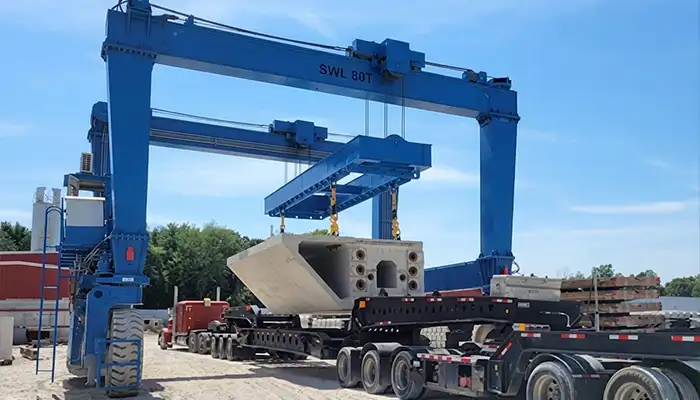 80 ton gantry crane for bridge construction, 80 ton rubber tyred gantry cranes for sale
80 Ton RTG Gantry Crane Solution Overview
For bridge and highway projects in the Philippines, the selected solution is an 80 Ton rubber tyred gantry crane (RTG crane). It is designed for outdoor lifting work where mobility and stability must work together on the same site. In simple terms, it is a mobile gantry crane that can travel freely on construction ground while handling heavy precast components.
Equipment Type and Configuration
The 80 Ton RTG crane is widely used in bridge construction where both lifting strength and site flexibility are required.
Main equipment configuration includes:
- 80 Ton Rubber Tyred Gantry Crane
- Diesel-powered RTG crane system for independent operation
- Heavy-duty lifting equipment designed for bridge construction work
- Mobile gantry structure suitable for large outdoor sites
This combination allows efficient handling of precast bridge components across changing jobsite conditions.
Key Technical Data
The following parameters represent a typical configuration used in highway and bridge girder handling projects.
| Parameter | Specification |
|---|---|
| Capacity | 80 Ton |
| Span | 20 m |
| Lifting Height | 30 m |
| Travel System | Rubber Tyres (Mobile Travel) |
| Tire Configuration | 8 Wheels |
| Power System | Diesel Engine |
| Engine Power | ≥400 HP |
| Control System | Hydraulic Operation |
Practical Meaning for Buyers and Project Teams
For project managers and procurement teams, these specifications directly affect how the crane performs on site rather than just being technical figures.
- 80 Ton capacity: suitable for standard precast bridge girders used in highway projects
- 20 m span: covers wide construction zones without frequent repositioning
- 30 m lifting height: supports elevated bridge structures and installation clearance
- 8-wheel system: improves stability on uneven construction ground
- Diesel engine ≥400 HP: enables independent operation without external power supply
- Hydraulic control: ensures smoother lifting and more precise girder positioning
What This Means in Real Construction Work
In actual site operations, this type of RTG gantry crane is selected because it can complete the full lifting cycle within one system.
- Lift heavy precast girders
- Travel across the construction site
- Position components for bridge assembly
This reduces dependence on multiple machines and helps maintain a more organized and continuous construction workflow.
What Makes This Design Practical for Philippine Contractors
In bridge and highway projects in the Philippines, equipment is usually judged in a very direct way: will it work on our site, with our ground condition, and our schedule. Not in theory, but in daily use. This is where the RTG gantry crane design becomes practical for many contractors and project managers.
"Puwede sa kahit anong site" Mobility
On most infrastructure sites, conditions are not fixed. Work areas are open, long, and often divided into sections as construction progresses.
This is why mobility is one of the first practical requirements for contractors.
- Can work in open highway corridors without rail tracks
- Can move along long bridge construction sections
- Suitable for island-to-island infrastructure development where sites are spread out
- Can be repositioned easily as construction stages progress
In simple site terms, the crane follows the work, not the other way around.
Built for Heavy but Repetitive Work
Bridge construction is not a single lifting operation. It is repeated lifting work, carried out day after day across multiple segments.
So the equipment must be stable and consistent, not just strong.
- Designed for repeated lifting cycles of precast girders
- Maintains stability when handling long concrete beams
- Suitable for continuous daily operation without frequent adjustment
- Keeps performance consistent across multiple bridge segments
For site teams, this means fewer interruptions and more predictable construction progress.
Diesel Power for Real Site Conditions
In many construction areas across the Philippines, power supply is not always stable or even available, especially in remote or newly opened project sites.
That is why diesel-powered operation is commonly preferred.
- No dependence on external electrical grid
- Suitable for remote or developing project locations
- Can operate immediately after setup without waiting for power connection
As many site engineers would say:
"Hindi ka hihinto dahil walang kuryente." (Work does not stop just because there is no electricity.)
Stability That Contractors Can Trust
When lifting heavy precast girders, stability is critical because it directly affects safety and installation accuracy.
The RTG gantry crane uses a multi-wheel system to improve ground contact and load balance in real site conditions.
- 8-wheel configuration distributes load evenly
- Better adaptation to mixed or uneven soil conditions
- Improved stability during travel and lifting
- Safer handling of long and heavy bridge girders
In practice, this helps reduce unwanted movement and keeps lifting operations more controlled during bridge beam positioning.
Safety – A Non-Negotiable Priority on Site
In construction work across the Philippines, safety is not treated as paperwork or formality. It is part of daily responsibility on site. Contractors, engineers, and supervisors all understand one simple truth—people go home safe, or the project stops. For this reason, when selecting an RTG gantry crane, safety is always checked as carefully as lifting capacity.
Built-In Safety Systems
An 80 ton rubber tyred gantry crane used for bridge girder handling is normally equipped with multiple protection systems. These are standard design features for safe field operation.
- Overload protection system
Prevents lifting beyond rated capacity, especially important when handling long precast girders with uneven weight distribution - Emergency stop system
Allows immediate shutdown during abnormal movement or unsafe conditions - Anti-collision system
Helps avoid contact with structures, vehicles, or other equipment on busy construction sites - Outrigger stabilizers
Improves stability during lifting and reduces risk of tipping when handling heavy beams - Full factory load testing before shipment
Each unit is tested under controlled conditions to confirm lifting performance before delivery to site
These systems work together during daily operation, especially in open construction environments where multiple activities happen at the same time.
On-Site Reality of Safety Management
In real construction work, safety is not only discussed in meetings. It becomes most important when heavy loads are moving, weather conditions change, or multiple teams share the same working area.
Many site supervisors in the Philippines often remind teams:
"Mas mahal ang aksidente kaysa equipment." (An accident costs more than the equipment itself.)
This reflects how contractors evaluate equipment during procurement—not only by price or capacity, but by how reliably it protects people, materials, and project timelines.
Why Safety Influences Equipment Selection
For bridge and highway projects, safety performance directly affects daily productivity and site confidence.
- Reduces risk during lifting of long precast girders
- Improves control in busy and shared construction zones
- Supports stable operation under changing site conditions
- Helps maintain consistent project progress without interruptions
That is why safety systems are a key decision factor when selecting an RTG gantry crane for girder handling work in infrastructure projects.
FAQ – Practical Questions from Contractors & Buyers
In many RTG gantry crane for sale inquiries coming from bridge contractors, project engineers, and procurement teams in the Philippines, the questions are usually very direct. People want to know if the equipment can really handle precast girder lifting, not just what the brochure says.
Why do contractors choose an RTG gantry crane for bridge construction projects in the Philippines?
A: Because it can handle heavy precast girders while still moving freely across changing construction sites without needing rails.
- In highway and bridge projects, the work area keeps shifting as segments are completed
- A rubber tyred gantry crane system allows lifting and traveling in the same operation
- It reduces delays caused by repositioning fixed lifting equipment along long bridge alignments
Is an 80 ton RTG crane enough for highway bridge girder installation?
A: Yes, 80 ton capacity is commonly used for standard precast concrete bridge girders in medium and large infrastructure projects.
- Many bridge construction RTG crane applications are designed around 60–100 ton lifting requirements
- It can safely handle typical highway beam segments with proper lifting configuration
- Suitable for precast concrete girder handling and transportation on site
Why is crane mobility such an important factor in construction site planning?
A: Because bridge construction sites in the Philippines are long, staged, and constantly changing as the project moves forward.
- Contractors often search for a mobile gantry crane solution for highway projects due to shifting work zones
- Access roads and lifting points are temporary and move along the bridge line
- A movable RTG system helps keep the lifting process aligned with construction progress
What makes a rubber tyred gantry crane more practical than a fixed gantry crane?
A: It removes the need for rail installation and allows direct movement on the construction ground.
- No rail foundation means lower civil preparation cost and faster setup
- Suitable for outdoor heavy lifting equipment in bridge construction environments
- Can be repositioned easily for different beam installation points without dismantling
What should buyers confirm before ordering an RTG gantry crane for a highway project?
A: Buyers should confirm lifting requirements, site conditions, and working layout before finalizing the crane specification.
- Maximum girder weight and lifting frequency for accurate capacity selection
- Ground condition for safe operation of a rubber tyred gantry crane system on uneven soil
- Required span, lifting height, and travel distance along the construction corridor
- Power system choice, especially for remote or temporary construction sites where diesel operation is preferred
How do contractors ensure safe operation during precast girder lifting?
A: They rely on built-in safety systems and proper load testing before the crane is used on site.
- Overload protection and anti-collision systems are standard in heavy duty RTG gantry crane designs
- Emergency stop functions help control unexpected site risks during lifting
- Factory load testing ensures the crane is ready for 80 ton bridge girder handling operations before delivery
What This Means for Contractors in the Philippines
For many project managers, site engineers, and procurement teams working on highway and bridge projects in the Philippines, the decision is rarely just about numbers on paper. It is more about how the equipment behaves once it reaches the jobsite, under pressure, under weather, and under changing work conditions. At the end of the day, the conversation on site is usually very straightforward: you don't just need lifting capacity—you need something that actually works on the ground, day after day.
What contractors really prioritize on site
In real project planning, especially for bridge construction RTG crane applications and precast girder handling operations, the focus usually comes down to practical field performance rather than theoretical specifications.
- Reliable field performance when working long hours outdoors
- Flexibility to follow changing construction stages along the highway alignment
- Stable operation even when the ground condition is not perfect
- Smooth coordination with multiple teams working in the same area
It is not uncommon to hear from engineers during planning discussions:
"Hindi sapat yung kaya lang magbuhat. Kailangan tuloy-tuloy ang trabaho." (It is not enough that it can lift. The work must keep going.)
Why RTG gantry crane fits this working mindset
A rubber tyred gantry crane system is often selected because it supports real construction flow rather than only theoretical lifting plans.
- It can move directly within the construction corridor without rail dependency
- It supports continuous precast concrete girder lifting and installation work
- It adjusts easily as the bridge construction progresses in stages
- It reduces downtime caused by repositioning or equipment change
This allows the crane to actively follow the construction sequence instead of waiting idle between operations.
Practical conclusion for project decision-makers
For contractors and procurement engineers, the final decision usually becomes clear after comparing how equipment performs in real site conditions.
- Not only lifting strength, but how smoothly it works on uneven construction sites
- Not only specification sheets, but how it supports daily workflow pressure
- Not only installation capability, but how it adapts to changing site layouts
That is why an RTG gantry crane for bridge construction projects in the Philippines is often selected—it aligns with how projects are actually executed on site, not just how they are designed on paper.
Final Buyer Insight
When contractors in the Philippines plan a bridge or highway project, the decision about lifting equipment is usually closely tied to how the site will actually run day to day. It is not only about capacity, but also about how smoothly the work can move from one stage to the next. If your project involves highway expansion along long construction corridors, bridge girder installation with precast segments, large outdoor lifting and transportation of concrete beams, or continuous handling of heavy structural components across changing work zones, then a rubber tyred gantry crane (RTG crane) is often not treated as a secondary option—it becomes part of how the whole project is organized and executed on site.
Why it matters in practical project execution
On many infrastructure sites, delays usually come from coordination issues rather than lifting strength. Equipment that cannot move easily or adapt to changing conditions often slows down the entire workflow.
- It can follow the construction progress along the site
- It supports repeated girder lifting without complex repositioning
- It fits staged bridge construction methods commonly used in highway projects
- It allows work to continue even when site layout changes
On-site mindset from Filipino engineers
In real field discussions, engineers often summarize the situation in a very practical way:
"Basta kaya ng site, kaya ng crane—ang importante tuloy ang trabaho." (If the site can handle it, the crane can handle it—the important thing is that the work continues.)
This reflects a common working principle in local construction projects: keep the job moving, avoid unnecessary interruptions, and ensure the equipment supports the construction pace instead of slowing it down.
Final takeaway for buyers and project teams
For procurement teams, contractors, and project managers, the key point is simple. A crane is not only selected for its lifting capacity, but for how well it fits into real site conditions.
In highway and bridge projects, an RTG gantry crane often becomes part of the execution plan itself—supporting not just lifting work, but the overall flow of construction from start to completion.
Inquiry Checklist For Fast Quotation
When contractors or procurement teams in the Philippines request a quotation for an RTG gantry crane, the most efficient way is to share clear project information from the beginning. This helps the technical team understand the site condition and prepare a suitable proposal without delay. In bridge and highway projects, especially for precast girder handling and installation, even small missing details can affect the final crane configuration.
Basic Project Information to Prepare
For fast quotation and technical review, please prepare the following key project details:
- Project type (highway / bridge / infrastructure)
- Maximum girder weight
- Span and lifting height
- Site ground condition
- Working schedule and urgency
- Power preference (diesel or hybrid)
These details help define the correct rubber tyred gantry crane configuration for your site conditions.
Detailed Technical Information Required
To speed up quotation and engineering review, the following information is especially important:
- Project type (highway, bridge, or general infrastructure work)
Defines whether the crane is used for girder lifting, segment installation, or general handling tasks - Maximum girder weight
Helps select correct RTG gantry crane capacity with proper safety margin for real site lifting - Span and lifting height requirements
Ensures full coverage of bridge alignment without frequent repositioning - Site ground condition
Soil type, compaction level, and site preparation status for stable rubber tyred gantry crane operation - Working schedule and urgency
Affects delivery planning, configuration, and project execution timing - Power preference (diesel or hybrid)
Diesel RTG cranes are often preferred in Philippine sites due to limited or unstable power supply
What You Will Receive After Submission
Once complete project details are provided, a tailored RTG gantry crane solution can be prepared for your site requirements.
- RTG gantry crane layout design based on your construction area
- Technical proposal matched to your girder handling requirements
- Recommended configuration for span, mobility, and lifting height
- Project-based quotation aligned with your schedule and budget planning
A clear inquiry ensures the rubber tyred gantry crane solution for bridge girder handling in the Philippines is properly matched to real site conditions, not just standard specifications.

Article by Bella ,who has been in the hoist and crane field since 2016. Bella provides overhead crane & gantry crane consultation services for clients who need a customized overhead travelling crane solution.Contact her to get free consultation.